Handle With Care: A Designer’s Guide to Cabinet Hardware
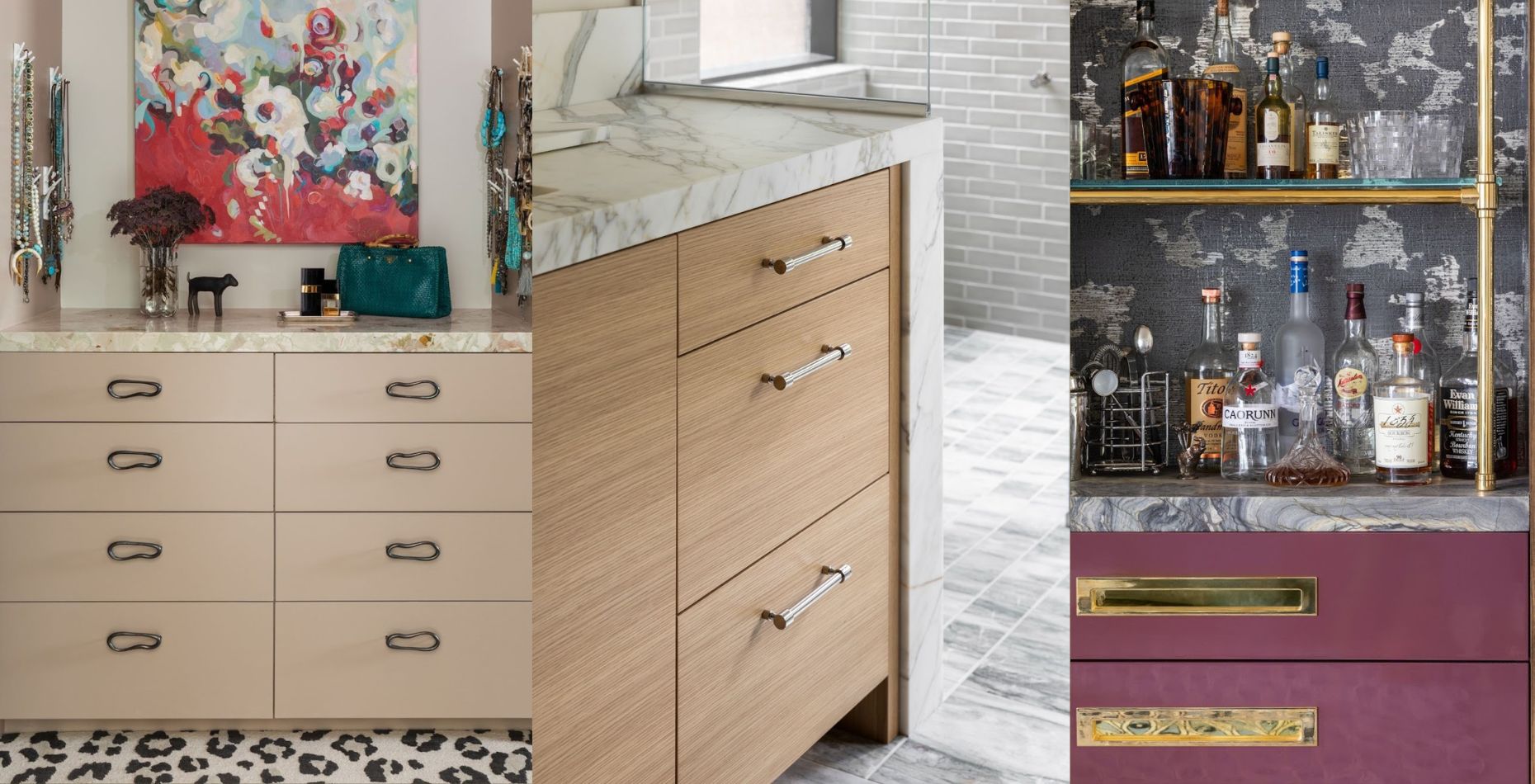
Here’s something you likely don’t think about much until you design or renovate a home…cabinet hardware.
Cabinet hardware is a workhorse, yet most people treat it as an afterthought when planning a space.Think of hardware as the jewelry of your cabinetry, and like any good piece of jewelry, the details matter. The right pull or knob can take a kitchen or bathroom from nice to unforgettable.
So, before you default to whatever happens to be on the shelf at your local hardware store, I’m going to break down everything you need to know about selection and placement. Then you get to go off and focus on the fun stuff!

Knobs vs. Pulls – The Big Conundrum
First things first–what is a knob and what is a pull? To this day, I call them by the wrong name. Aren’t you pulling on either one? Yes, you are, but let’s make things a bit more clear.
A knob is a piece of hardware that is often round or ball shaped and typically needs only one screw to fix it to the cabinet door or drawer.
A pull is very simply a handle. I couldn’t tell you why we don’t just call it that in the industry, but maybe “pull” sounds fancier. A pull usually has two points of connection to the cabinetry.

So, what goes where?
More often than not you will find knobs on cabinets and pulls on drawers, but that is absolutely not a hard and fast rule. Deciding which to use and where comes down to how it looks and how it feels in your hands.
Pro Tip: For extra wide drawers, use two knobs to balance the weight and make it easier to open. If using pulls, you can either do a pair or choose one wider pull.


Thoughts on Size
Selecting a size for your cabinetry hardware is one of those decisions that sounds simple until you’re standing in a showroom holding a three-inch pull next to a towering bank of cabinetry and something feels very off. Here’s what to keep in mind.
- Balance is key and scale starts with the cabinet itself. A petite knob on a large drawer front looks lost, while an oversized pull on a delicate cabinet looks clunky. When in doubt, favor proportion over preference.
- Don’t just look at hardware – pick it up. Grasp it the way you would actually use it in your kitchen. If you have larger hands, you will want more clearance between the pull and the cabinet face. On the other end of the spectrum, smaller and more refined hardware is entirely appropriate in a child’s room or a more delicate space.
- For the heavy lifters, like trash pull-outs, dishwashers with cabinet fronts, or anything that takes a beating daily, I suggest choosing beefier hardware. Larger, more substantial pulls not only look the part, they hold up to the job.
Pro Tip: Keep the extension of the knob or pull in mind so that it doesn’t catch on your clothing or prohibit another cabinet from opening fully.

Finishing Touches
We like to keep the cabinet hardware finish consistent in any given space, but don’t feel bound to matching every metal in the room. Cabinet and door hardware can share a finish while the plumbing fixtures and lighting go their own way. The mix creates a very bespoke look.
Pro Tip: If you want to work with multiple finishes but aren’t sure where to start, mixed metal hardware is your shortcut. We like to use it in limited amounts so that it’s enough to feel considered and special, but not so much that it starts to feel busy.

Getting the Placement Right
No matter what type of hardware you choose, I have a very specific formula for how I like it placed on drawers. For a bank of drawers, install the pull (or knobs) centered top to bottom on the smallest drawer (usually the uppermost drawer).
Take the measurement from the top of the drawer to the center (screw point) of the hardware, and place all of the other drawer pulls at the same distance from the top of the drawer. If you have a 6” drawer, that means the screws will be 3” from the top, so all of your hardware would be 3” from the top no matter how large the drawer. To me, this is a more elegant solution than centering the hardware on all of the drawers.
Focus on alignment when planning cabinet hardware installation. If you have a drawer next to a door, for example, line the top of the horizontal drawer pull with either the top of the vertical cabinet door pull or with the cabinet knob.
Pro Tip: On deeper drawers, hardware set in the middle tends to look lost and you have to reach further to access it.

The Fun Part
Now that we’ve covered the basics, let’s talk about the fun stuff! Sometimes you want your hardware to stay simple, but there are times when you may prefer for it to take center stage. There is so much out there to choose from and there is truly something for everyone. From crystal to bone, and organic shapes to bold linear forms, the right piece of hardware can add drama, inject a little whimsy, or become the unexpected detail people can’t stop talking about.

Friendly Reminder: Keep your eyes peeled for an upcoming Perspective blog post where we show you some of the newest, sexiest hardware on the market!