Room for Inspiration: Six Designs I Keep Coming Back To
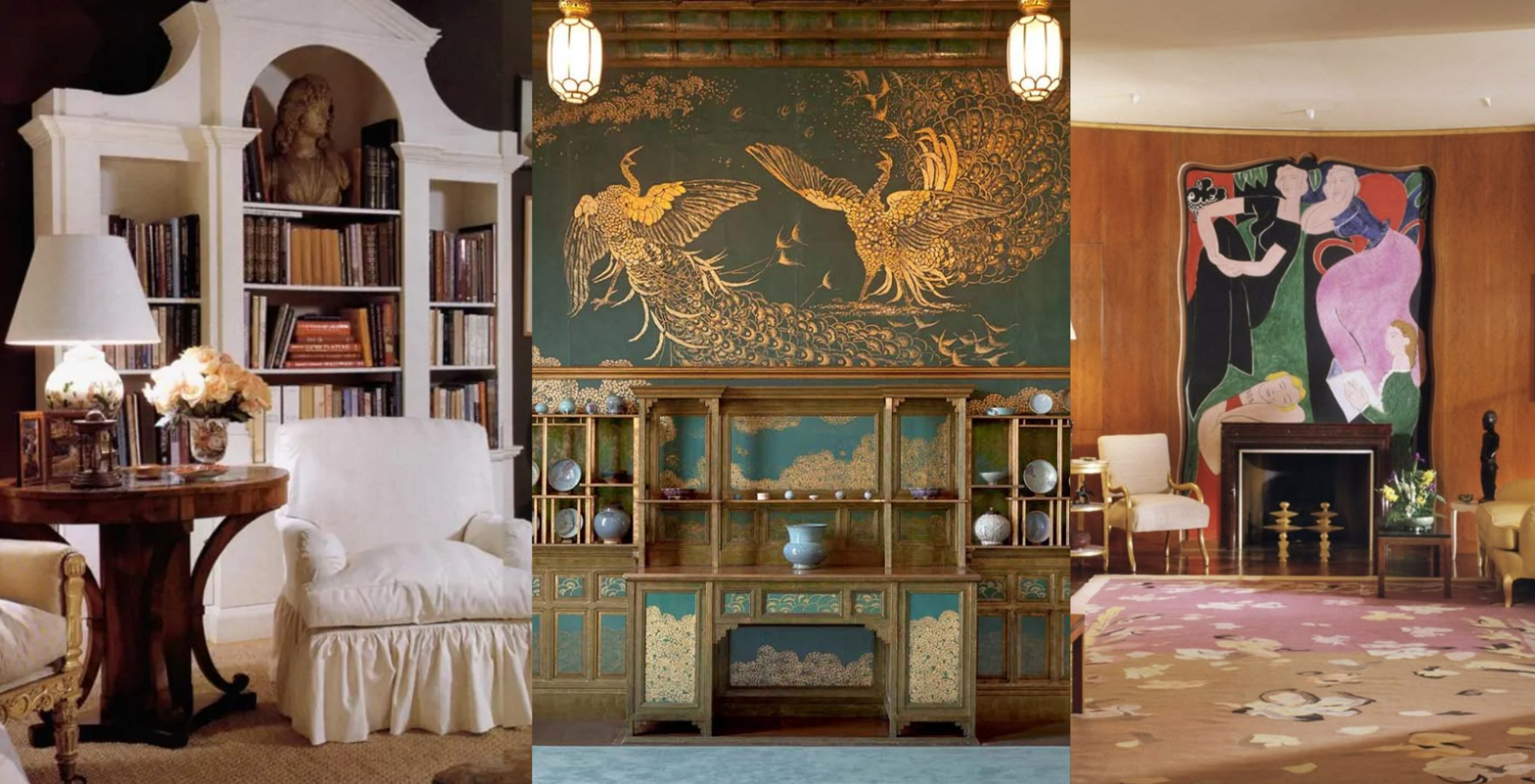
I’ll warn you that this is a deeply personal list—these are the rooms that have inspired me throughout my career. This isn’t necessarily about the incredible talents who created the spaces (although some have very interesting stories), nor is it about the projects as a whole.
What I love about looking at a single room is that they are a microcosm of something larger, and as such, they are more digestible, like a single gem in a tiara.
And what all of these spaces share is a sense of timelessness. Each boasts a strong presence and several display an adept use of color. But ultimately, what I believe makes them classic is their distinct personality. You can study these rooms over and over again, and always find something in them that captivates.
Read on for the lesson each of these six spaces has taught me.
Jean-Michel Frank
I have always had a love for Art Deco where sculptural curves and a sleek aesthetic bridge the chasm between classic and contemporary design. You may not have heard of Jean-Michel Frank, but his work during the 1930s and 40s has influenced generations of designers. This living room is a master class in enduring style and is as relevant today as it was more than 90 years ago.
Lesson: Elegant, fluid shapes and rich, evocative hues will always be in style.

The Peacock Room
It isn’t just the astonishing palette of blues and greens accented with gold that makes The Peacock Room (housed at the Smithsonian National Museum of Asian Art) so intriguing. It is the repeated use of the peacock as a motif—everywhere—in its entirety, and as smaller decorative elements.
This design of this shipping magnate’s London dining room was completed by James McNeill Whistler to house the owner’s collection of blue and white porcelain and reflects a period of global interest in art for art’s sake. Its history is full of drama. To learn more, check out this short video from the Smithsonian.
Lesson: An unapologetic commitment to a motif or design has the power to take something from average to extraordinary.

Vicente Wolf
Vicente Wolf is a living legend whose work I have admired since the start of my career, and this room is a constant source of inspiration.
There is so much to discover at every turn—the view reflected in the lacquer ceiling and mirror is a stroke of brilliance. Moving the bed away from the wall is unorthodox, and the mix of modern and Asian pieces sparks interest.
Lessons: Accentuate key architectural details. Mixing design elements catches your eye and keeps your interest.

Houston's Menil House
Designed in 1948, Houston’s Menil House, home to art collectors Domenique and John de Menil is a study in contrasts. The organized simplicity of Philip Johnson’s architecture paired with interiors decorated by couturier Charles James are interdependent, one highlighting the very best of the other.
Lesson: The foyer’s antique settee surrounded by modern art and architecture is an unparalleled example of how beautiful the juxtaposition of new and old can be.

Mark Hampton
I remember being shocked when I first saw this brown living room very early in my career. Today we use deep, rich color all the time, but back then, it was unheard of.
Mark Hampton’s classic design has stuck with me always because of his pairings—seagrass with neoclassical busts, and crisp whites with toasted brown tones. He was doing high-low before it was even a thing.
Lesson: Balance is everything. It’s all about that push and pull. If you have a yin, you gotta have a yang.

India Mahdavi
This kitchen is a riot of seemingly unmatched pattern and color, but in the hands of India Mahdavi, it is perfect. Rather than take center stage, the boldness blends into a harmonious and happy whole.
Lesson: Color and pattern are acts of joy. Don’t be afraid to lean in fully.
